Jersey → France → Jersey: My Two-Way Crossing

Sometimes the swims you don’t plan for turn out to be the ones you need to do and learn from.
Jersey to France was not on my list of swims this year.
I knew about the swim, of course, but I had other swims planned and other goals I was working towards. Then those plans fell over and fortuitously a slot for Jersey with my coach Tim became available, and I thought:
Why not?
The original plan was Jersey to France. But as we talked about it, the idea of turning it into a two-way crossing — Jersey → France → Jersey — started to make sense.
It made sense because I am working towards my next big swim project, United By Water — a 125km swim from Dubai to Abu Dhabi that I expect will take around 30 hours in the water.
Thirty hours. That is a very long time to be swimming.
So this swim was never just about getting from Jersey to France. It was about time in the water. It was about learning more about how my body and mind respond when the hours keep ticking by. It was about putting myself through a longer swim and using it as preparation for what is to come.
And if I was going to be in the water for a long time anyway, why not swim back?
So the two-way crossing was born.
Jersey → France → Jersey.
As it turned out, I was going to get plenty of time in the water.
There was also something rather special about the timing.
I swam 100 years and one day after Gertrude Ederle became the first woman to swim the English Channel. In 1926, Gertrude didn’t just swim across a stretch of water. She broke through a barrier and showed what women could do in a sport that was, at the time, still very much dominated by men.
In the 100 years since Gertrude’s pioneering swim, so many strong and powerful women have followed behind her — pushing boundaries, redefining what is possible in sport and influencing thousands of young women along the way.
I love that I get to do that too. The achievement matters, of course. But so does what happens because someone was brave enough to go first.
I hope my swim and my journey can add, in some small way, to that story. I hope it might inspire another woman to take on a goal, push beyond what she thinks is possible and reach new heights.
But getting myself to the start line was far from smooth.
In fact, six weeks before the swim, I wasn’t even sure I was going to swim it. A lot was going on in my life.
I was travelling for work. I was travelling for family. I was trying to keep training going along with everything else and while this is something I am pretty used to doing, that is not to say it is always easy. In fact a lot of the time it isn’t.
This training block saw me step out for training sessions in Seattle Washington State, Perth in Western Australia, Ho Chi Minh City, Dunraven Bay in Wales and Jersey — too many pools, lakes and oceans to count!
Aside from my work travel commitments, something else was different.
Menopause was absolutely kicking my butt.
I was exhausted. I had insomnia. My recovery was terrible. My joints ached. I was trying to keep everything moving while feeling like my body was working against me. I was being held together by physio and massage.
And there comes a point where you have to be honest with yourself.
Ultra-marathon swimming is hard enough when you arrive at the start line healthy, rested and ready to go. It is a very different proposition when your starting position feels like you are already 5km behind the start line.
I needed to sort myself out or this swim simply wasn’t going to happen.
So six weeks out, I stopped and took a really good look at what I was doing.
I went back to basics with my nutrition. I doubled my protein intake. I added more magnesium and vitamin D, and started taking ashwagandha. I also took myself off to my GP to talk through what was going on with me.
Not because younger female athletes don’t do these things — of course they do.
But as an older athlete going through menopause, I find myself constantly checking in with my body, trying to understand what it needs and how I can keep it performing at the level I am asking it to perform. The struggle was real I can tell you that much.
And six weeks out from this swim, I finally acknowledged something: What I had been doing wasn’t working which is never easy to admit. Especially when you have spent years learning your body, understanding your training and believing you know what works for you.
But sometimes there is no perfect formula. Sometimes there isn’t even a neat scientific answer. Sometimes we just have to tweak things as we go.
Try something.
See what happens.
Listen and feel.
Adjust.
Try again.
And eventually you find a formula that works. Mine certainly isn’t perfect but slowly, things started to come together. My body began to respond. Training started to feel like training again rather than something I was simply surviving. My recovery improved and I started to feel more like myself.
I wasn’t suddenly in perfect shape. I hadn’t magically solved menopause. There was no miraculous six-week transformation. I had simply made some changes, listened more carefully to my body and done what I could to give myself the best possible chance.
And somehow, it was enough. Enough to get me to the start. Enough to get me into the water.
And, as it turned out, enough to get me there and back again.
The Week Before
The final week before the swim was all about getting myself into the right place — physically, mentally and emotionally.
I flew to Cowbridge in Wales, a small village just outside Cardiff and home to one of my very close friends. For the five days leading into the swim, I made my base at my friend’s home, Plas Llanmihangel, a beautiful — and apparently haunted — castle in the Vale of Glamorgan.
Staying at the Plas turned out to be exactly the right choice.
The quiet surroundings of the castle gave me space to slow down. I could spend time with my friend, get some good training in at the Vale Resort pool and swim at Dunraven Bay.
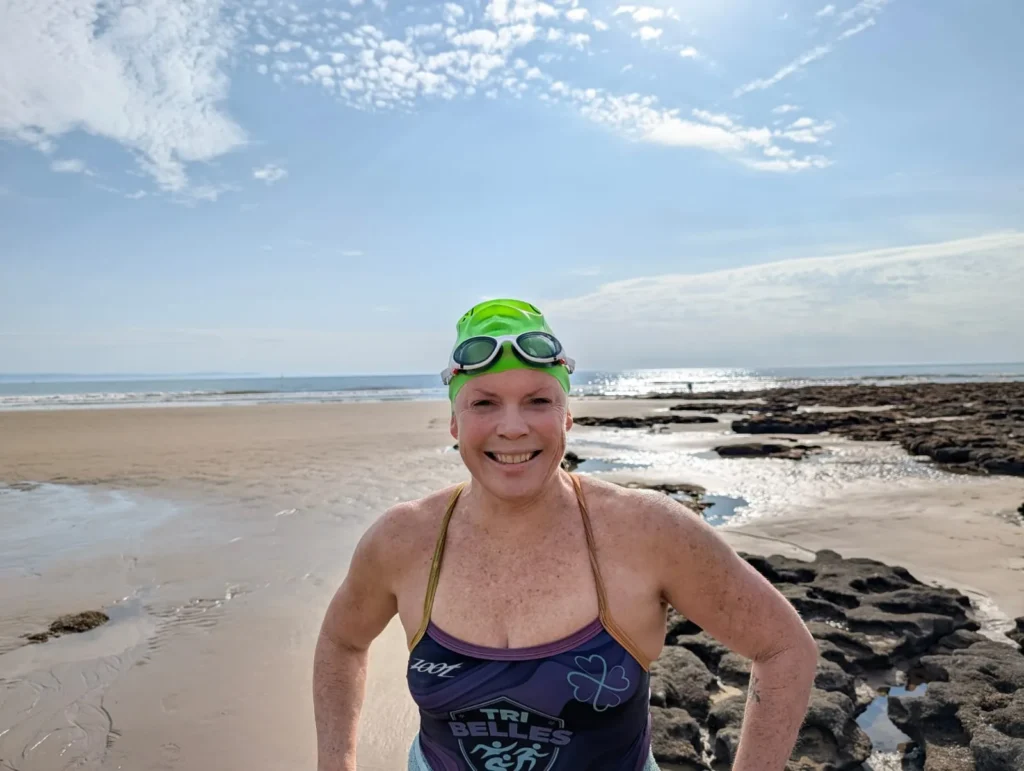
It was a lovely balance of training, recovery, friendship and simply being somewhere that felt calm.
I also spent my 56th birthday in Wales and, because every good swim needs a bit of carb loading, I celebrated with a fabulous pub lunch. It was all part of the plan.
One of the reasons I had chosen to arrive in the UK early was to give myself time to adjust to the time zone and, hopefully, eliminate any jet lag before the swim.
After the previous six weeks, when I had been working hard to get my body back on track and travelling for work, I didn’t want to arrive in Jersey feeling like I was already playing catch-up.
So the week was deliberately uncomplicated.
Swim.
Recover.
Eat.
Rest.
Spend time with a good friend.
Repeat.
When it was time to head to Jersey, I flew out of Bristol on a little propeller plane – I can’t remember the last time I flew on one of those. Just one hour. Easy. No stress. And, most importantly, no drama.
It was a great lead-up to the swim.
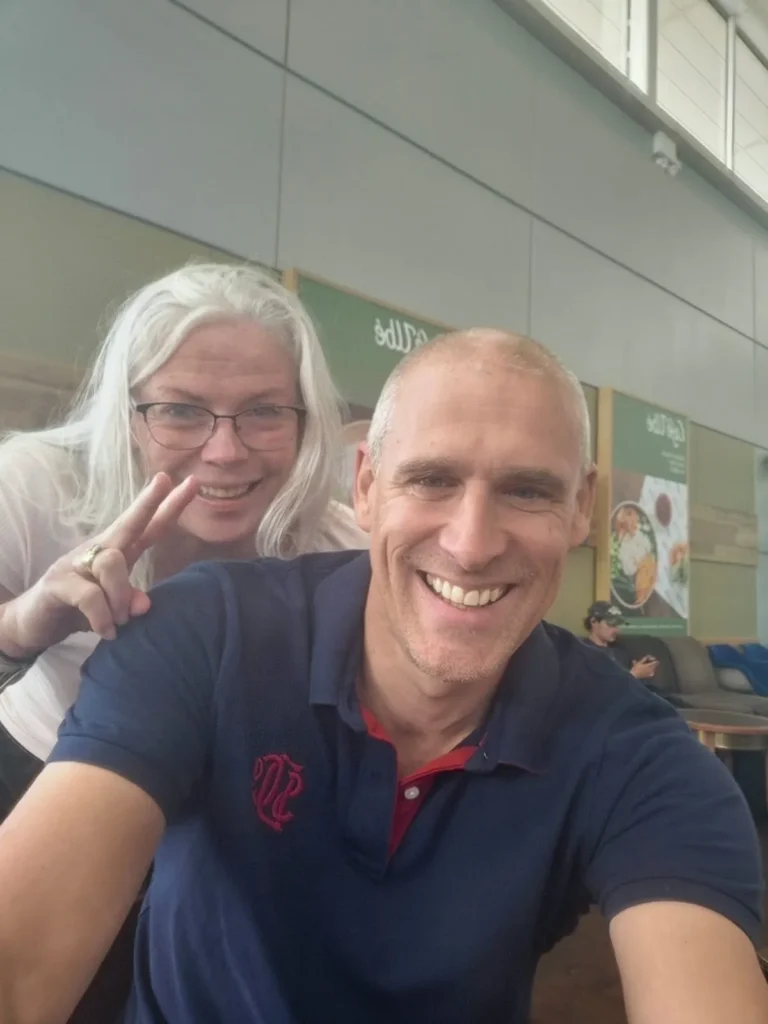
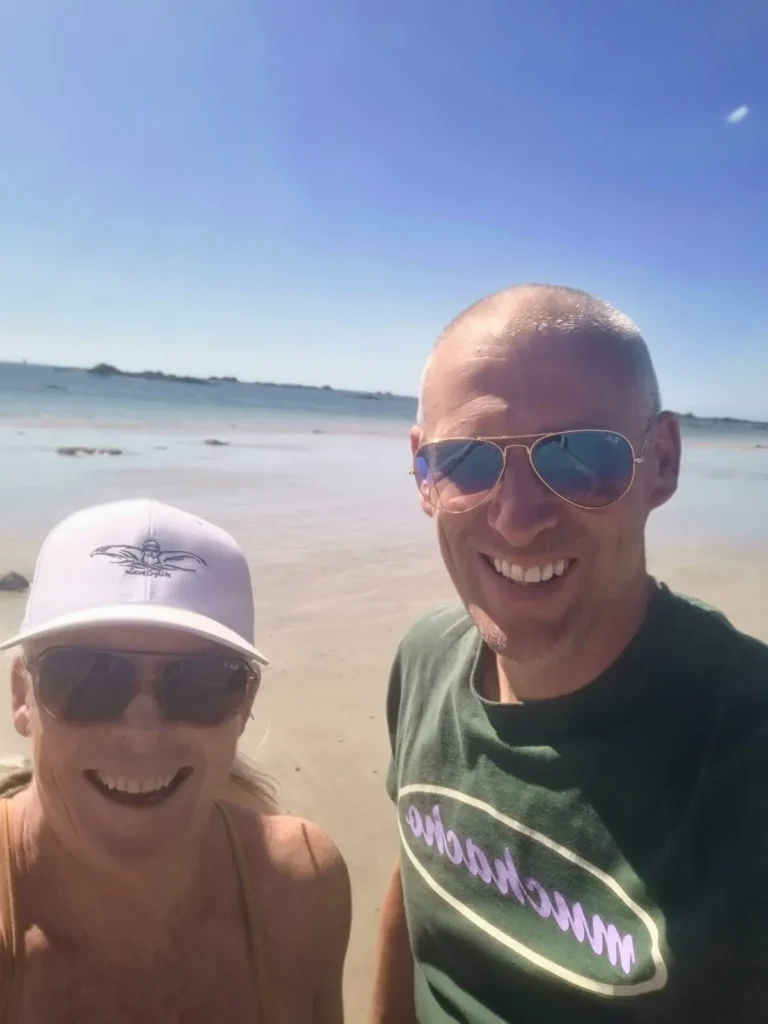
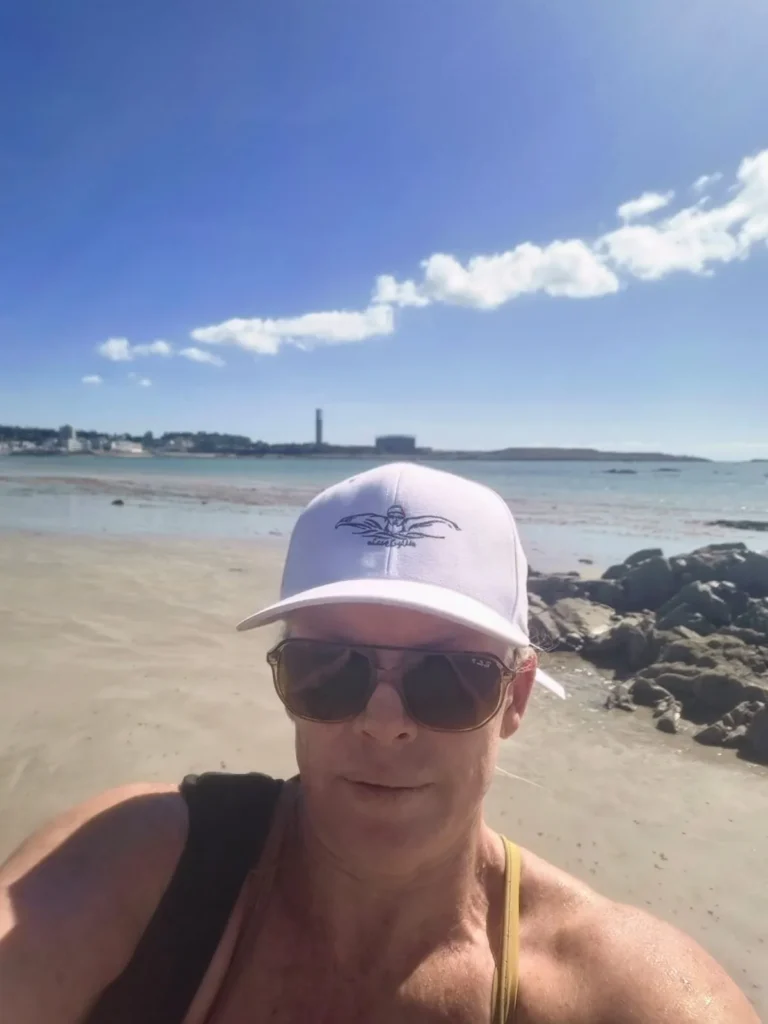
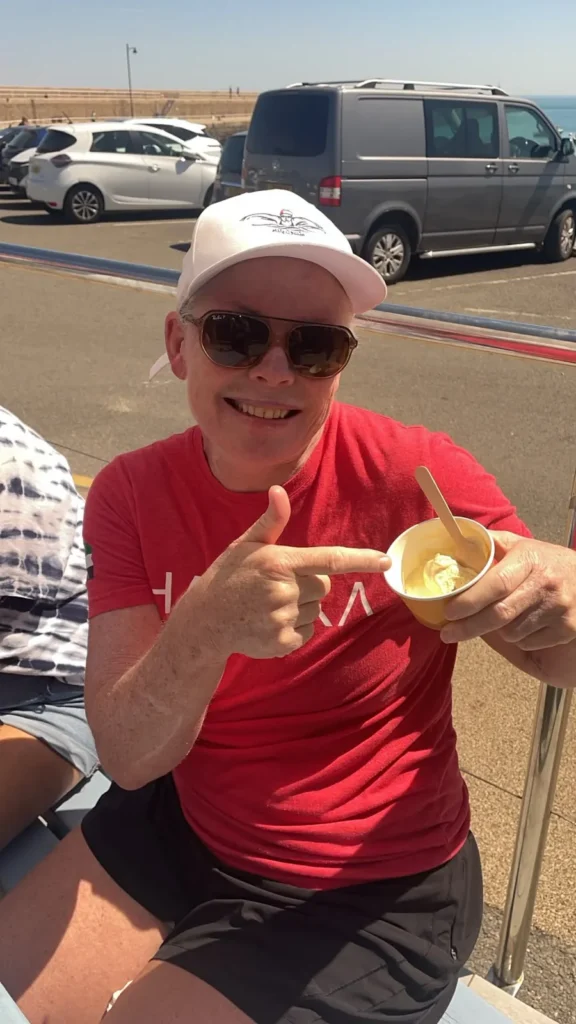
Everything felt calm and in place and I felt ready. Well as ready as you can ever be when you are about to get into the sea and swim for a very, very long time.
Into the Water
At around 6:45pm on Saturday 7 August, I entered the water at St Catherine’s Beach to start the two-way crossing.
Before boarding Lionheart, I stood on the opposite side of the breakwater and looked across at the starting beach. I could hear the wind howling and thought – didn’t think this wind was meant to be part of the plan! The winds had been expected to drop away except they hadn’t! They had picked up instead!
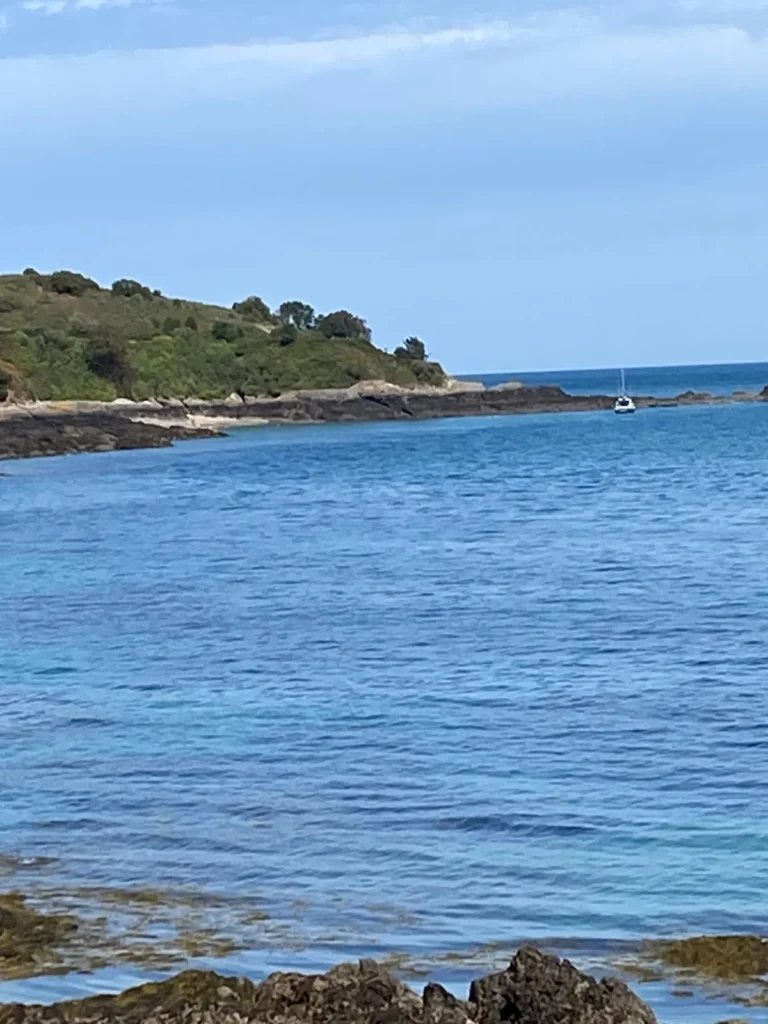
For the first five hours, I was swimming in Force 6 winds — around 21 knots. Brutal is the word that comes to mind. I was swimming in a washing machine.
At times my head was completely under the water and I wondered how the boat could possibly see me at sunset, let alone during the night when all they would be able to see was the flashing red lights attached to my goggles and bathers.
I was more under the water than on top of it. I really had to focus during those first 5 hours.
Feel the waves. Is there a pattern, think body position, breathe, rhythm. Swim closer to the boat. Move away from the boat. Be positive. Be strong. Be grateful. Celebrate — even when it is hard.
My coach Tim later told me it looked like I was “punching the water.”
It certainly felt that way.
As Professor Mike Tipton wrote in his published work in October 2024, and spoke about in the documentary Don’t Be Prey:
“There is a clear difference between endurance ability and the ability to endure.”
Professor Mike Tipton
Those first hours were not really about my endurance ability. They were about my ability to endure.
To keep going despite the discomfort, fatigue, swallowing salt water, uncertainty and psychological stress. In ultra-endurance swimming, this distinction truly matters. I now fully understand that distinction.
And I showed myself that, despite the conditions, I could continue to endure for many more hours.
On the way to France, I sang songs.
Who knows where they came from, but here they are:
Bonnie Tyler — Total Eclipse of the Heart
Air Supply — All Out of Love
Corey Hart — I Wear My Sunglasses at Night
I’m a little old school and these were on a mix I had played on Spotify before I left for my swim.
I absolutely didn’t need a love song in my head while battling the conditions, but once a song is in my head, it is very hard to get it out, but I did manage to switch across to Total Eclipse of the Heart — not really that much better however I have to say I hit those high notes perfectly in my head!
After the songs disappeared, I talked to my Dad, Caina and Speedy, asking them, well more like begging them — for some heavenly magic to calm the sea.
It didn’t work.
Maybe on my next swim they will listen.
So I endured.
As we approached the French shoreline, the water flattened. Finally, I could simply swim. Bilateral breathing. Brain in neutral. Just moving through the water. It was a relief to switch my concentration off for a while.
Then came Saint-Germain Beach.
One Way Would Never Have Been Enough
The original plan for the first leg was for Tim to paddle the kayak with me into shore.
Instead, as we neared the beach, Tim told me the boat would be able to get very close to shore and that I would just swim in under the spotlight. I actually think Tim didn’t want to get out of his warm clothes! 🙂
To close out the first leg and start the second, I needed to walk out of the water, place my hands up to signal the end of the first leg, and then get straight back in and swim to the boat.
In hindsight, that was probably the best thing that could have happened.
Because somewhere during the night, I had already started convincing myself that maybe I could persuade Tim that one way was enough. I knew it would never be enough and that I would be so cross with myself for not finishing what I had started, but in those moments when it was really tough, one way was certainly looking good!
Luckily, there was no conversation to be had. I walked out. Turned around. And started my swim back to Jersey.
Guess I was doing that two-way after all.
As I swam back towards the boat, I needed the answer to the one thing on my mind:
“What are the conditions going to be like swimming home?”
I was told they were going to improve.
And they did — slightly.
Not the flat pond, which is every swimmer’s dream. There was still chop, plenty of slop and a long way to swim to get home.
One 30-Minute Feed at a Time
My focus for the return leg was simple:
Swim to sunrise, then focus on the next 30-minute feed.
Reset.
Stay in that 30 minutes. Some of those 30-minute feeds felt like two hours. But I got through them.
At one stage, I had the current behind me and I was trying to use every roll of the swell to my advantage — gaining a few extra metres wherever I could, doing anything I could think of to get me closer to Jersey.
It was during this time that another song popped into my head:
The Weeknd — I Can’t Feel My Face. So true at that stage, as my lips were well and truly numb from the salt water!
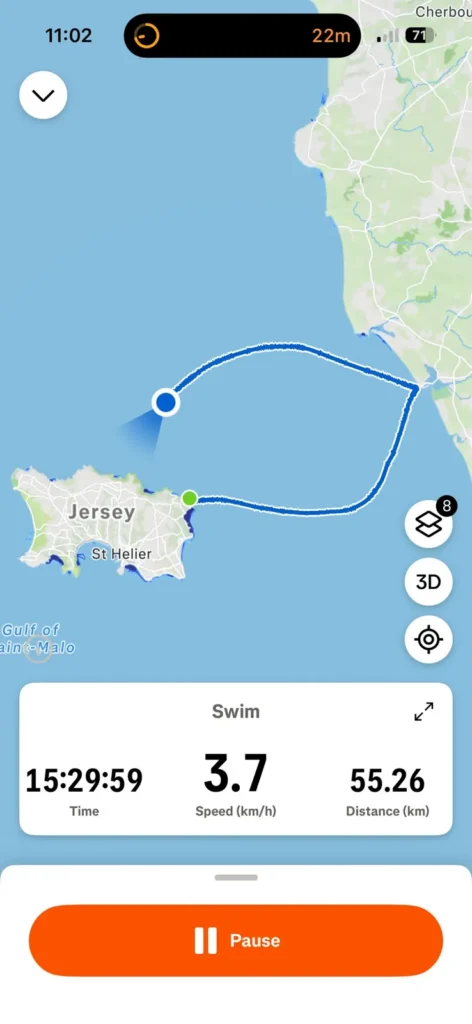
If you look at Tim’s Strava tracker, you’ll see that the double crossing looks like I swam a complete circle. That wasn’t by accident. It was by design. The return leg is much more technical because of the tides.
We needed to head up the French coast, cut across to drop into and catch the tide running back down towards Jersey, cross that tide again, and then catch the eddy back up the Jersey coast to the finish.
It required some serious technical expertise and precision from my pilot, Matt from Lionheart Charters, who handled the crossing brilliantly.
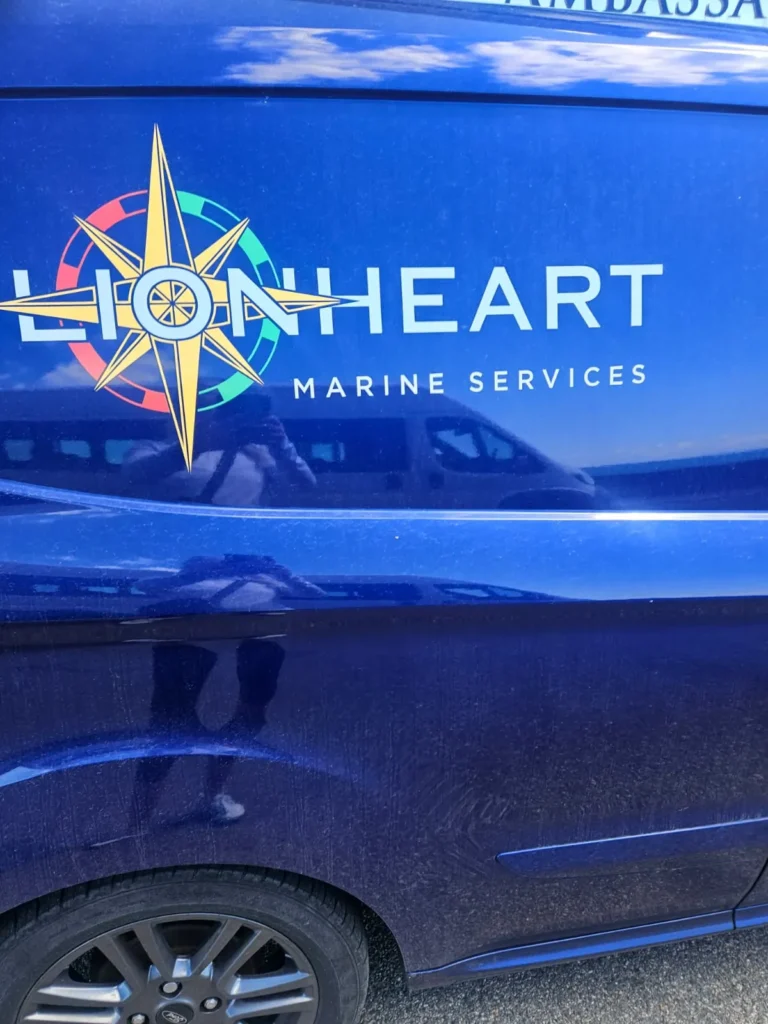
I had complete trust in him to navigate the conditions, tides and currents and get me home.
As I got to the six-hour mark on the way back, I knew I had broken the back of the return leg.
But there was still a long way to go.
At that feed I said to Tim:
“Well, I’ve counted 12 x 30-minute feeds. Do I need to count another six — which puts me at the nine-hour mark for the return leg?”
He said:
“Why not?”
OK, I thought.
I can do this.
Let the countdown begin.
Zero. I’m Done.
I was down to two feeds, which I thought represented about an hour to go.
I asked Tim for hard facts. I needed to know how long. How far. I was nearing the brink in my head.
Tim asked me to give whatever I had left. If I could lift just a bit, that might mean the difference between finishing within 30 minutes or going for another 45 minutes to an hour.
Gah.
That was not what I wanted to hear.
For those of you who know me, you can probably guess the delivery of my message back to Tim:
“Zero. I’m done, Tim. I’m over it. I just want to be done.”
Then came the news:
“If that is the case, 45 minutes to an hour to go.”
Not what I wanted to hear.
So I tried to lift, but as you will know, closing these swims out can be difficult.
You are done with it, but you have to keep going.
You are over yourself, but you need to continue to endure.
Fatigue has well and truly set in and the end just never seems to come quickly enough.
And I felt all of that deeply on that Sunday lunchtime. I was in a hole, that’s for sure.
But I also knew that I just needed to keep turning my arms over.
My two observers from JLDSA were standing on the side of the boat, clapping me in. I cried in my goggles.
I really needed that lift to close the swim out.
And then, finally, there it was.
St Catherine’s Beach
My start point and now my finish point. A full circle.
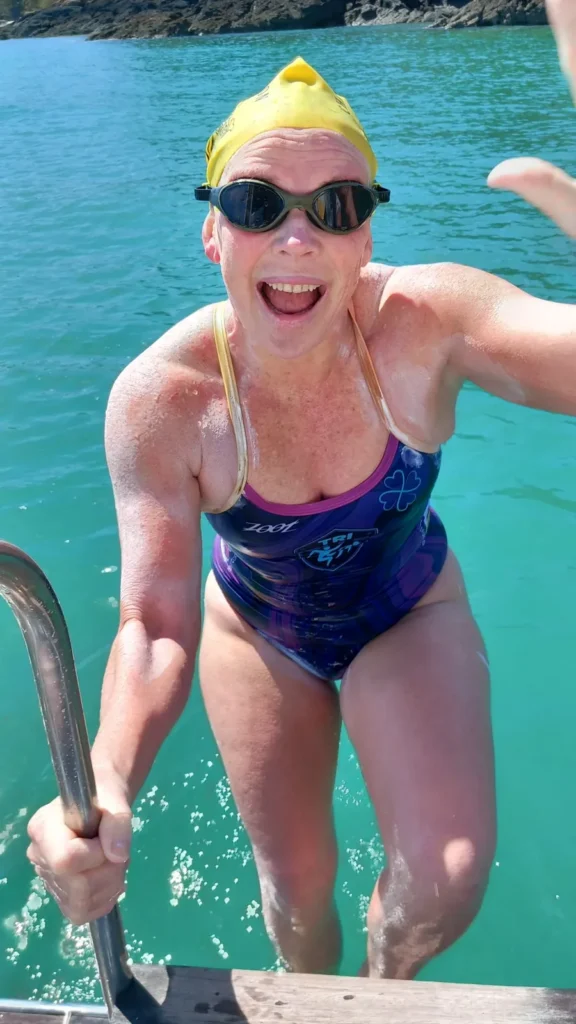
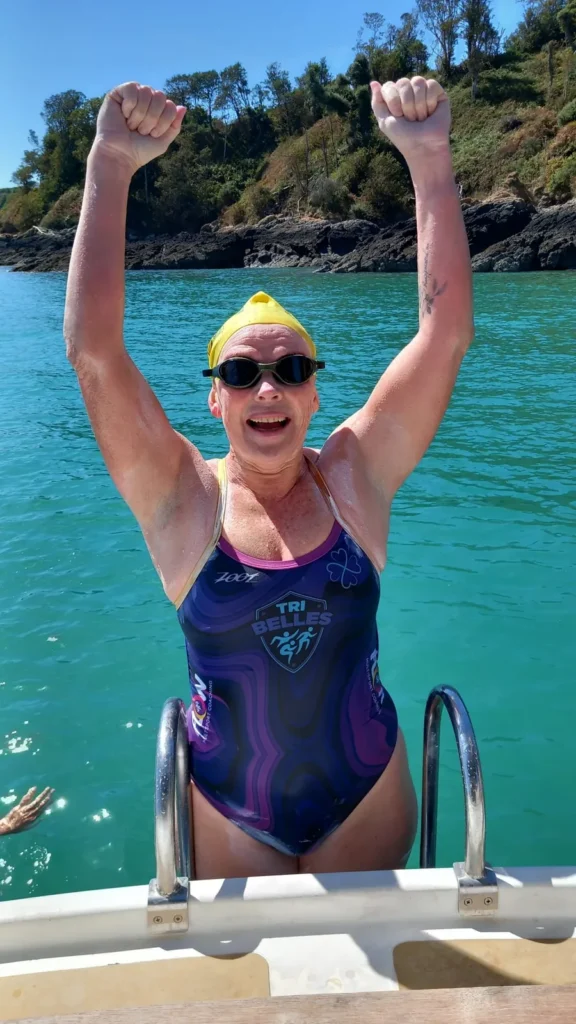
One final memory from this swim is swimming into shore and then clearing the water.
My friends Clare and Andy, who my husband and I met many years ago in Abu Dhabi, were waiting for me.
They had come over from Guernsey to see me finish.
A really special moment to have them waiting at the end.
I’ve never needed a hug more than in that moment.
St Catherine’s Beach.
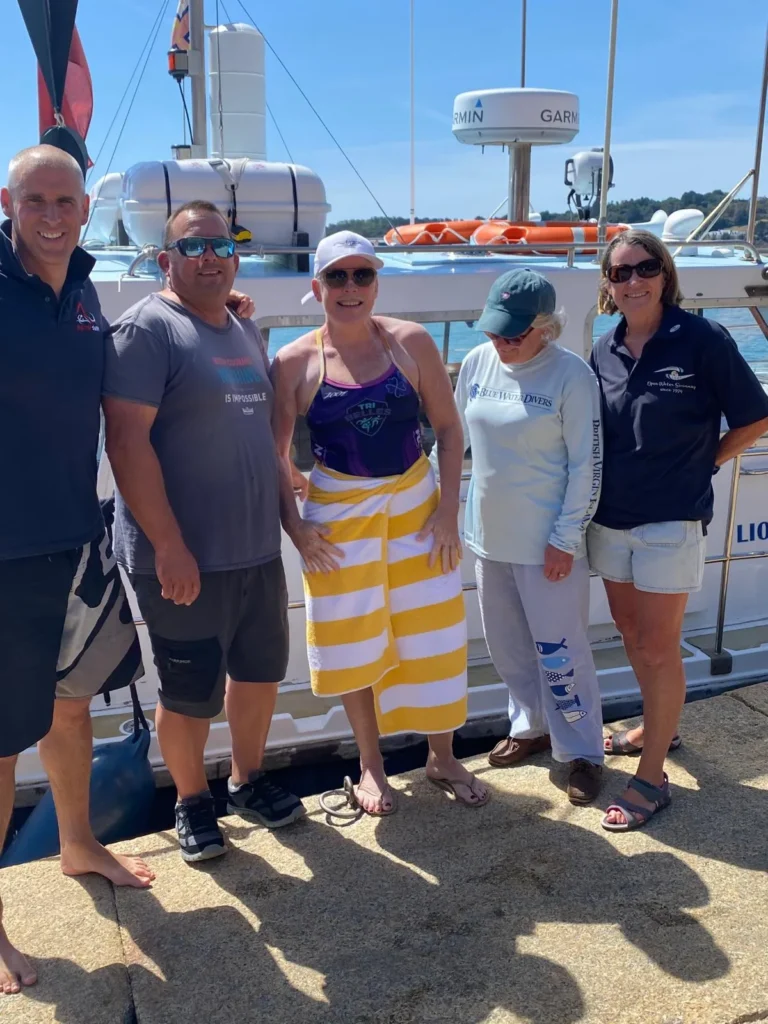
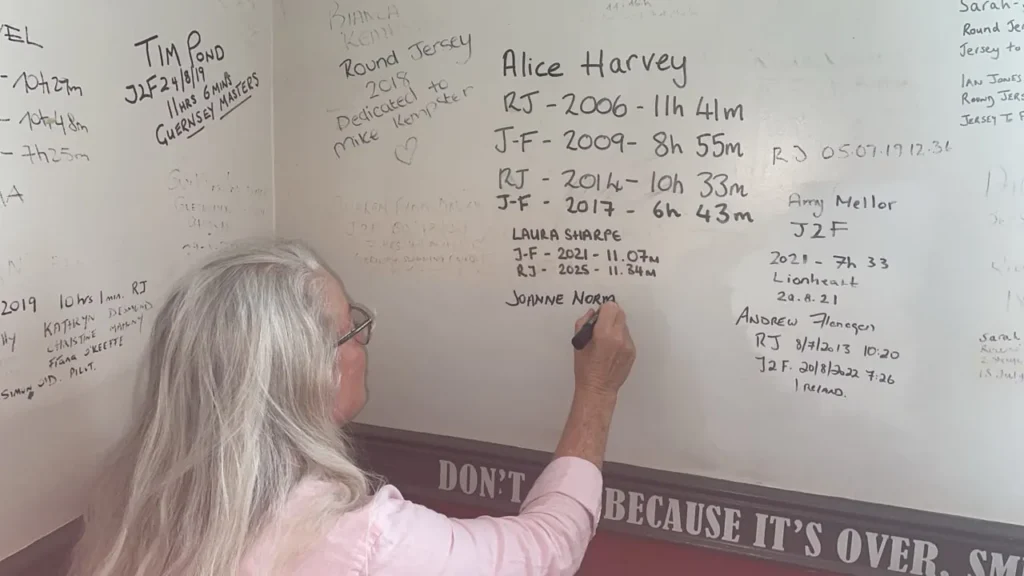
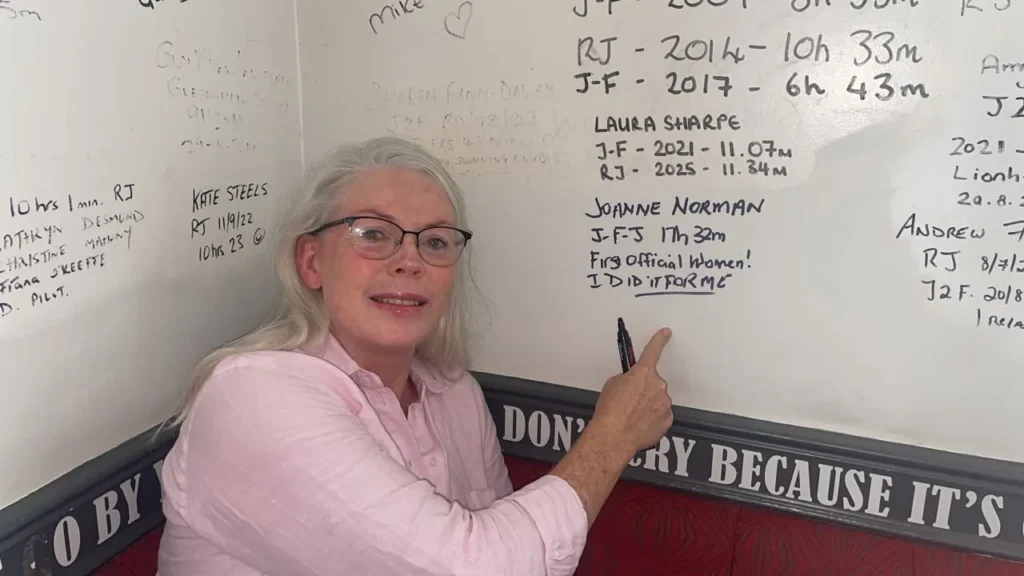
17 hours. 32 minutes.
Jersey → France → Jersey.
First woman to officially complete it.
Third person ever to finish the two-way crossing.
It’s never about the title. But what a privilege to have earned it.
The Things You Learn Along the Way
Before I close out this swim, there is one more thing I need to talk about.
Nutrition.
I totally failed my nutrition plan for this swim.
I didn’t pack enough for 17 hours.
I honestly thought I had enough. Even when I discovered, on arriving in Jersey, that the lid on my tin of Milo had opened and exploded in my bag on the flight over, I still thought I had enough.
Well, I didn’t.
Tim had to improvise on the go with what I had packed and what he had packed.
He found my recovery mix for after the swim — protein mixed with some collagen powder — and I got given that too.
There were Precision gels with caffeine, flat Coke, Endura, ginger cordial and anything else Tim could get his hands on once my Staminade and Milo had gone.
The only thing Tim didn’t use were the tinned peaches!
We also started with cold feeds, but with the conditions I was feeling cool early on in the swim — not cold, but cool enough that I wanted to start having hot feeds and stay on top of how my body was feeling.
Because Tim couldn’t warm the Coke, he swapped in ginger cordial.
There was a polite:
“Don’t give me that again.”
Why?
My throat was already raw from swallowing salt water and the ginger felt like glass going down over an already raw throat.
Plus, I could still taste it three feeds later.
So Tim had to find another solution.
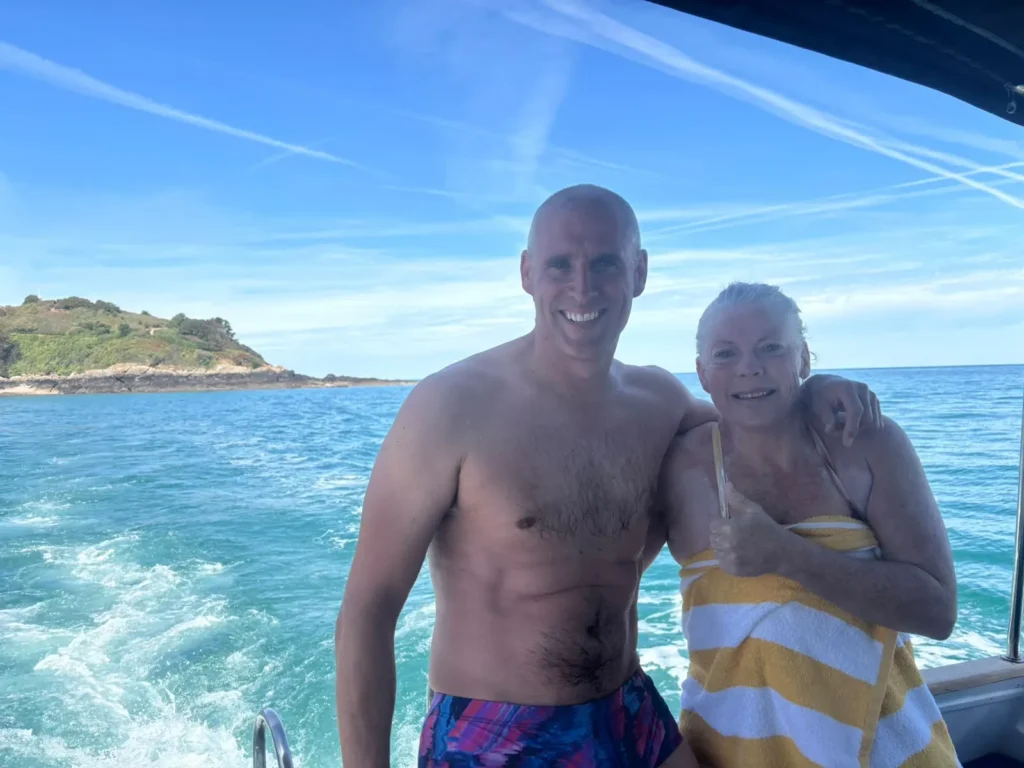
And this is exactly why I have my coach on the boat with me. When things go wrong or plans change, you need someone who can solve problems on the go.
Tim has a huge amount of experience and I trusted him completely with this swim and the many others we have done together.
And, as I think about the whole experience, that is perhaps one of the biggest lessons from this swim.
Preparation matters.
But preparation isn’t about getting everything perfect.
This swim was supposed to be preparation for United By Water.
And it was.
But perhaps not only in the way I expected.
It reminded me that preparation isn’t always about getting fitter or swimming further.
Sometimes it is about learning how to listen to your body.
Sometimes it is about recognising when what you are doing isn’t working and having the courage to change it.
Sometimes it is about looking honestly at your nutrition, recovery and everything you are doing outside the water and admitting that something needs to change.
Six weeks before this swim, I had to do exactly that.
I had to double my protein. Look at my supplements. Talk to my GP. Pay more attention to recovery. And accept that the formula I had been using wasn’t working for me anymore.
Then, on the swim itself, I discovered that my carefully planned nutrition wasn’t enough either.
So Tim adapted.
We improvised.
We worked with what we had.
And we kept going.
Sometimes there is no perfect science to all of this.
Sometimes we just have to tweak things as we go and find the formula that works for us.
It’s not perfect.
But I managed to get myself to the start line.
I managed to get into the water.
And I managed to get myself back to St Catherine’s Beach. This was a swim that demanded far more than endurance. It demanded the ability to endure.